
Lucky words on catalog clothing and the occasions they were made for
Good fortune, double happiness, long life, wealth: the words most often printed on catalog clothing come with a season or an event attached. What each says, when it fits, and the one or two that can misfire.
Good fortune at the New Year
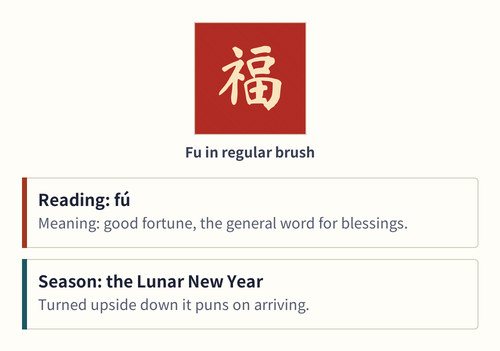
福 fú is the general word for blessings: the dictionary describes it as the collective name for wealth, rank and long life, or for lucky things in general (the Ministry of Education dictionary (Taiwan), revised edition: 福). It is the single character most likely to appear on red New Year goods, from door cards to sweatshirts.
On clothing it reads as seasonal good cheer, in the way a winter-holiday sweater does. Out of season it is still friendly, just slightly out of place. A brush-written 福 in gold on red is the classic look; a heavy sans-serif version reads more like streetwear.
You will sometimes see it upside down. That is usually deliberate: 倒 dào, upside down, sounds like 到 dào, to arrive, so the turned character announces that fortune has arrived. Not everyone agrees where it belongs; the details are on the mock-ups page.
Double happiness belongs to weddings
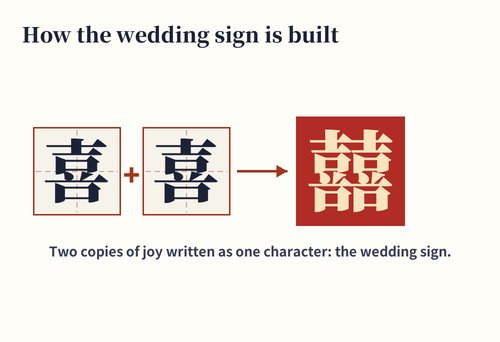
囍 xǐ is two copies of 喜, joy, written as a single character. The concise dictionary of the Ministry of Education calls it the character used at weddings, written double to show good luck in pairs, and popularly called “double happiness” (the Ministry of Education concise dictionary (Taiwan): 囍).
Even 喜 alone leans that way: one of its listed senses is “of marriage”, as in wedding invitations and wedding banquets (the Ministry of Education dictionary (Taiwan), revised edition: 喜).
So a 囍 print is a wedding print. Couples sometimes wear matching ones for the occasion, and that reads well. On a guest it can look like you are claiming the day for yourself. As everyday wear it usually comes across as a joke about marriage, which may be exactly what you want.
Long life, birthdays, and one caution
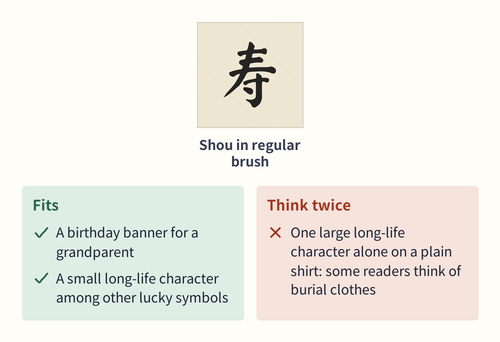
寿 shòu, traditional 壽, means long life, and also a birthday, especially an older person’s: the dictionary’s examples include a birthday celebration for an elder (the Ministry of Education dictionary (Taiwan), revised edition: 壽).
The same entry lists one more use, as a modifier for things prepared in advance for a burial, as in 寿衣 shòuyī, burial clothes. That is the caution. A small 寿 in a pattern of lucky symbols is fine; a single large 寿 on the front of a plain garment can make some older readers think of that second sense.
For a grandparent’s birthday, a 寿 print on a gift shirt is generous. For yourself, a phrase such as 平安, safe and well, gives a similar warmth without the overtone.
Shop-sign wishes for wealth
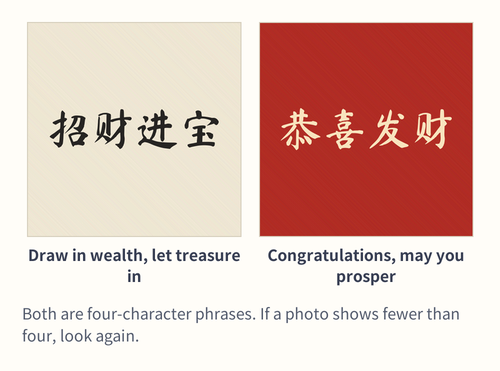
招财进宝 zhāo cái jìn bǎo wishes for wealth to be drawn in and treasure to enter; the dictionary glosses it as attracting fortune in order to get rich (the Ministry of Education dictionary (Taiwan), revised edition: 招財進寶). It is classic shop decor and New Year paper. On a tee it reads as a cheerful money joke.
恭喜发财 gōngxǐ fācái congratulates someone on getting rich, and the dictionary adds that today it is mostly a New Year greeting (the Ministry of Education dictionary (Taiwan), revised edition: 恭喜發財). Worn in summer it reads like a Christmas greeting worn in July: harmless, slightly comic.
Both are four-character phrases. If the photo shows only two or three characters, the print has been cropped or the design is a fragment; the idioms page explains why that matters.
Everyday blessings that travel well
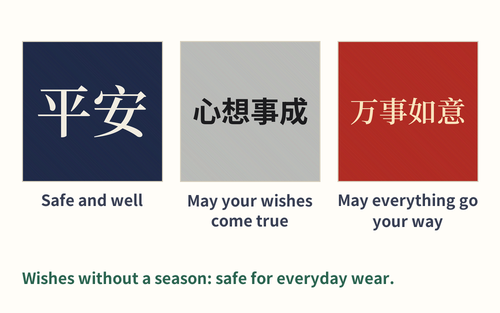
Some wishes are not tied to a date. 平安 píng’ān means safe and sound; the dictionary quotes a Tang poem asking a traveler to carry word home that the writer is safe (the Ministry of Education dictionary (Taiwan), revised edition: 平安). 吉祥 jíxiáng means auspicious (the Ministry of Education dictionary (Taiwan), revised edition: 吉祥).
The four-character wishes 心想事成, may your wishes come true, and 万事如意, may everything go your way, are greeting-card phrases the dictionary describes as used to wish others well (the Ministry of Education dictionary (Taiwan), revised edition: 心想事成; 萬事如意).
These are the safest lucky prints for daily wear. They are warm, a little generic, and unlikely to be misread.
Checking a lucky print before you order
Lucky words are short, which makes mistakes obvious to anyone who reads them. Before ordering, check four things in the seller’s own photo, not the mock-up:
- the character is the one in the title, and complete: 福 has a narrow radical on the left and a wider right side built from three parts;
- it is upright, unless the design is meant to be turned;
- a four-character phrase shows all four characters, in order;
- the color fits the mood: lucky words are traditionally red and gold; white or black versions are a modern take, which is fine, just different.
If the listing only shows a mock-up, ask for a flat photo of the garment. The picking notes have the wording to use.
Images: catalogue photographs are category examples, not this site’s purchases or verified Mulebuy orders. Drawn material, dimension and lettering examples explain a concept; they do not certify the depicted product.