
Second meanings on clothing: green hats, white, clocks, fish and English written for China
Some messages ride on color, sound or animal rather than on the words. These are the ones a Chinese reader is likely to notice, how serious each is, and who English slogans on Chinese-market clothing are written for.
The green hat
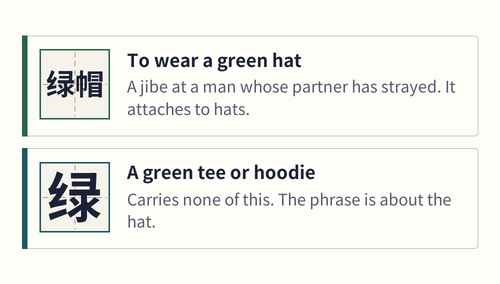
To wear a green hat, 戴绿帽子 dài lǜ màozi, is a jibe at a man whose partner has been unfaithful; the dictionary records it in exactly those terms and points to an older form, the green headscarf (the Ministry of Education dictionary (Taiwan), revised edition: 戴綠帽子).
A plain green cap is ordinary sportswear and few people will think twice. The joke wakes up when the cap also carries Chinese writing, or when it is given as a gift to a man. Neither is a disaster; both can raise a grin you did not plan.
If you like green, a green hoodie or tee carries none of this. The phrase is about the hat.
White, red and the two kinds of occasion
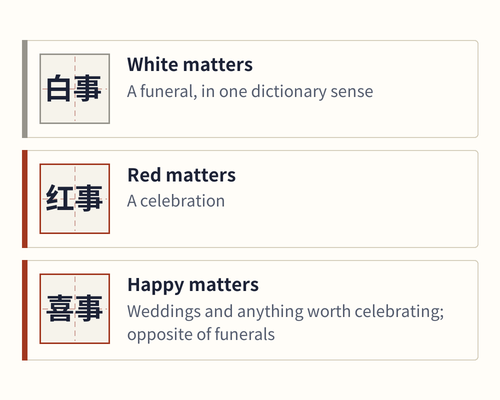
Chinese has a pair of plain words for the two great family occasions. 白事 báishì, white matters, means a funeral, in one of its dictionary senses (the Ministry of Education dictionary (Taiwan), revised edition: 白事). 红事 hóngshì, red matters, means a celebration (the Ministry of Education dictionary (Taiwan), revised edition: 紅事).
Day to day, a white tee is just a white tee. The link matters at the edges: white clothing with Chinese writing on it, worn to a family celebration, can look out of key, and red and gold read as festive. 喜事, happy matters, covers weddings and anything else worth celebrating, and the dictionary lists funerals as its opposite (the Ministry of Education dictionary (Taiwan), revised edition: 喜事).
This is why lucky words are nearly always printed red, and why a black-on-white 福 reads as a modern design choice rather than a traditional one.
Sounds that carry a second message
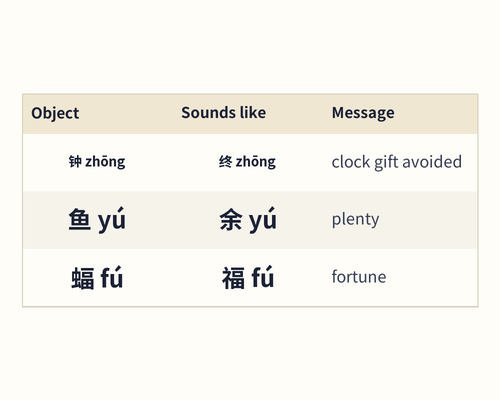
Chinese has many words that sound alike, and some objects borrow meaning from their sound. A clock, 钟 zhōng, sounds like the end of life, 终 zhōng; to give a clock, 送钟, sounds exactly like 送终, to attend a parent at the deathbed (the Ministry of Education dictionary (Taiwan), revised edition: 送終; entry for 鐘). Clock gifts are usually avoided for that reason.
The same mechanism makes things lucky. Fish, 鱼 yú, sounds like surplus, 余; the dictionary entry for the New Year phrase 年年有余 says outright that fish are served at the New Year for that sound (the Ministry of Education dictionary (Taiwan), revised edition: 年年有餘). A bat, 蝙蝠 biānfú, ends on the syllable of good fortune, 福 fú (the Ministry of Education dictionary (Taiwan), revised edition: 蝙蝠).
So a fish print reads as plenty, and a clock print is merely a clock unless it is a present.
Animals that can turn into a taunt
Most animal prints are cheerful. One needs a note. 乌龟 wūguī, the turtle, is in the dictionary both as an animal and as an insult: a man whose wife is unfaithful, and a coward, as in the phrase for a turtle pulling in its head (the Ministry of Education dictionary (Taiwan), revised edition: 烏龜).
A cartoon turtle on a child’s tee is just a turtle. A turtle with Chinese writing about the wearer, or a turtle on a gift for an adult man, may be read as a jab. That is all; nobody will be offended by a turtle on a beach towel.
For the lucky end of the zoo, fish and bats carry good sounds, as above. We do not cover the stories behind animal motifs, only what readers take from them today.
English slogans written for a Chinese audience
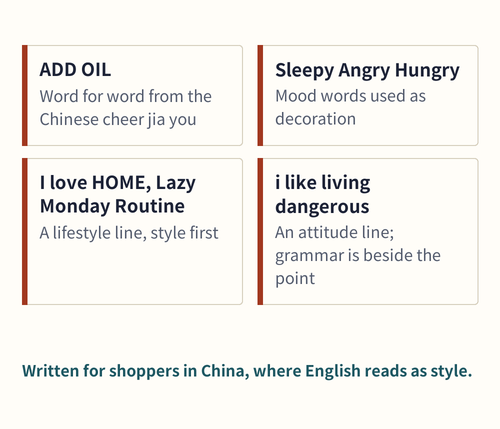
Much of the English on catalog clothing was written for shoppers in China. For that audience English works the way French or Italian words work on clothing sold in the United States: it signals style first, and grammar is beside the point. So you get caps that say “Sleepy Angry Hungry”, a cap that says “I love HOME, Lazy Monday Routine”, and a hoodie with a black cat and “i like living dangerous”, all on our home page.
Some English is a direct rendering of a Chinese phrase. “ADD OIL” translates 加油 word for word: the dictionary gives its literal sense as adding fuel and its figurative sense as making more effort (the Ministry of Education dictionary (Taiwan), revised edition: 加油). A reader who knows the Chinese gets the joke; a reader who knows only English sees a slogan about fuel.
None of this needs correcting. If you buy one, you are wearing a phrase pitched at a different reader, which can be the fun of it.
When a second meaning is worth thinking about
Almost never, for something you wear yourself. A short list where it is worth a second thought:
- a 囍 print at someone else’s wedding;
- a large 寿 alone on a garment, for its link to burial clothes;
- a green cap with Chinese writing, given to a man;
- any clock as a gift, whatever is printed on it;
- white garments with characters, worn to a family celebration.
Gifts deserve more care than your own clothes, because the receiver’s family may read the print more literally than you do. When unsure, a 平安 or a 心想事成 is hard to get wrong.
Images: catalogue photographs are category examples, not this site’s purchases or verified Mulebuy orders. Drawn material, dimension and lettering examples explain a concept; they do not certify the depicted product.