
Slang tees, idioms cut short and lines borrowed from poems
Internet slang, four-character idioms and famous lines of poetry all end up on catalog clothing. Here is what the common ones say, where their dates come from, and why a half-printed idiom looks odd to a reader.
Lying flat and working for a wage: slang that made the lists
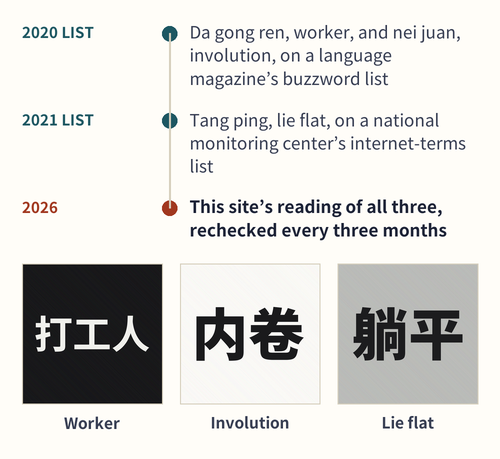
躺平 tǎng píng means, in the dictionary, to lie down flat; the dictionary has no entry yet for its online sense (the Ministry of Education dictionary (Taiwan), revised edition: 躺平). Online it means stepping back from the pressure to keep striving, and it appeared on the list of the year’s top internet terms that the National Language Resources Monitoring and Research Center published in December 2021 (the list as published).
打工人 dǎgōngrén and 内卷 nèijuǎn came a year earlier, on the 2020 buzzword list of the language magazine 咬文嚼字. The notes published with that list say 打工人 first meant mostly manual and migrant workers, spread after a short video in September 2020, and became a name for workers of every kind; 内卷, a sociology term translated from “involution”, was taken up by students for pointless competition (list notes, December 2020).
On a tee all three are self-mocking. They say “I am tired of the race” with a shrug, which is why they sell.
Office jokes and words of encouragement
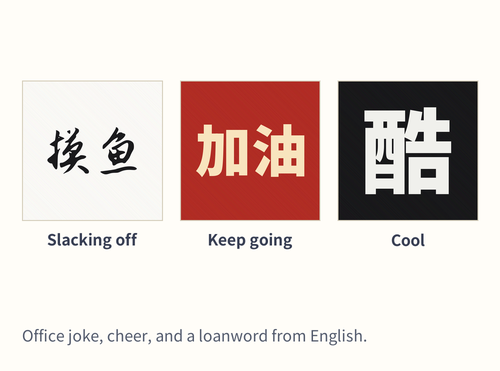
Some slang is older and plainer. 摸鱼 mō yú literally means feeling around in the water for fish; the dictionary’s second sense is not doing the work properly, with the example “stop slacking during office hours” (the Ministry of Education dictionary (Taiwan), revised edition: 摸魚). On a shirt it is a cheerful office joke, often drawn with a fish.
加油 jiā yóu is to add fuel; figuratively it means putting in more effort, and it is what people shout to cheer someone on (the Ministry of Education dictionary (Taiwan), revised edition: 加油). You will see it on sportswear and on gifts for students before exams.
酷 kù once meant cruel or very; today it is the sound of the English word cool, with that meaning, and the dictionary says so (the Ministry of Education dictionary (Taiwan), revised edition: 酷). A single 酷 on a black tee reads exactly as you would hope.
How quickly a slang print goes stale
Slang lists are editorial choices, not counts. When the editors of the 2022 buzzword list explained their picks, they said 摆烂 bǎi làn, roughly letting things rot on purpose, ranked near the top of their word-frequency survey and was left off for its negative meaning (their explanation, December 2022).
For a buyer this means two things. A word on a list is a word people recognized that year, not a word that will stay fresh. And a popular word can still be one that some readers find sour.
We mark every slang reading on this site as 2026 usage, read by us, and recheck the slang entries every three months; the lucky words and idioms are checked once a year. If a reading changes, the updates page says so.
Idioms cut in half and lines lifted from poems
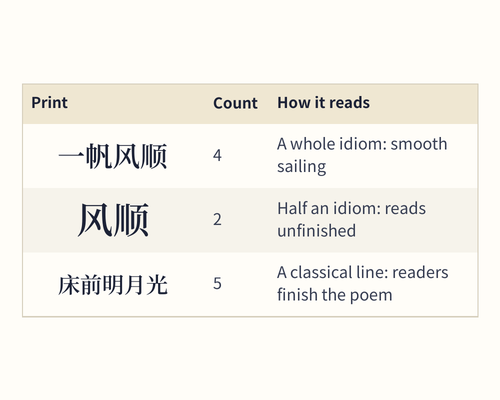
Chinese idioms, 成语 chéngyǔ, are mostly fixed four-character phrases, and readers know them as units. 一帆风顺, one sail and a following wind, means everything going smoothly (the Ministry of Education dictionary (Taiwan), revised edition: 一帆風順). Print only 风顺 and a reader will feel the missing half, the way “sailing” alone looks cut off from “smooth sailing”. Sometimes that is the design; often it is a crop in the photo.
Poem lines work the same way. 床前明月光, moonlight bright in front of my bed, opens Li Bai’s “Quiet Night Thoughts”, and most readers will finish the poem in their heads. The wording itself has variants: one old collection of Li Bai has 牀前看月光, and the familiar line follows the anthology 唐詩三百首 (the poem in three editions).
So count the characters. Four for an idiom, five or seven for a classical line; if the photo shows fewer, ask why.
Four-character idioms worth recognizing
A handful of idioms account for most of what you will see on lettered clothing. Besides 一帆风顺:
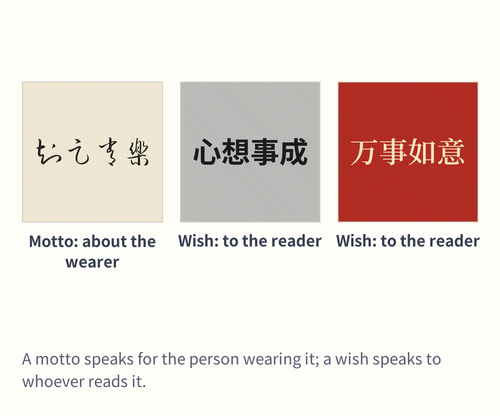
- 知足常乐 zhī zú cháng lè, knowing when you have enough keeps you happy; a calm personal motto (the Ministry of Education dictionary (Taiwan), revised edition: 知足常樂);
- 心想事成 xīn xiǎng shì chéng, may your wishes come true; a birthday-card phrase (the Ministry of Education dictionary (Taiwan), revised edition: 心想事成);
- 万事如意 wàn shì rú yì, may everything go your way; festive, often seasonal (the Ministry of Education dictionary (Taiwan), revised edition: 萬事如意).
The first is a statement about the wearer; the other two are wishes for whoever reads them. That difference is the closest thing to a rule for wearing idioms: a motto reads as personal, a wish reads as friendly.
Reading a slang or idiom print before you buy
Tone is the thing to check. Slang that mocks the wearer, such as lying flat or slacking off, is friendly among friends and odd in a formal setting. Idioms are safe nearly everywhere. Poem lines read as thoughtful, sometimes wistful.
We left crude slang off this site on purpose, along with anything political or religious. If a print you like is not covered here and the listing title does not explain it, the safest step is to ask the seller what it says and compare the answer with a public dictionary. Glyph match has the slang and idiom samples side by side if you want to compare shapes first.
Images: catalogue photographs are category examples, not this site’s purchases or verified Mulebuy orders. Drawn material, dimension and lettering examples explain a concept; they do not certify the depicted product.